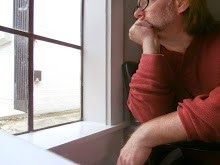
Like lightning dressed in snow, the news struck.
"Do not be afraid . . . "
We've heard this before.
"I know that you are looking for Jesus . . . "
We were followers.
"He is not here . . . "
Death harshly separates us.
" . . . see the place where he lay."
And now we don't even have a grave to visit, to venerate.
" . . . go quickly . . . "
The quick and the dead . . .
". . . Galilee; there you will see him."
Do not raise our hopes!
"Do not be afraid . . . "
Galilee may be closer than you think . . .
Sunday, March 31, 2013

Saturday, March 30, 2013
Holy 2013
Saturday. .
We know the story. Behind us is death, in front of us is resurrection .
But today is between time.
We don't know how to look at it, how to observe it.
Between grief and joy.
Between disappointment and hope.
Between losing and gaining.
It's ambiguous time, poorly defined, too often ignored with busy-ness.
We can't think about that now, there are things to do.
We live here more than this one days admits.
We know the story. Behind us is death, in front of us is resurrection .
But today is between time.
We don't know how to look at it, how to observe it.
Between grief and joy.
Between disappointment and hope.
Between losing and gaining.
It's ambiguous time, poorly defined, too often ignored with busy-ness.
We can't think about that now, there are things to do.
We live here more than this one days admits.
Friday, March 29, 2013
Good 2013
There are things you can't control.
The love you have. The anger you feel. Sometimes they spill out.
You love the wrong people. You get angry at the wrong people. You speak the truth to both.
The Reign of God is among you.
You can't control the need to say so.
Love the wrong people and give them hope.
Make the wrong people angry and they're confronted with how paltry their power really is.
You can only tell them the truth.
You can't control what they do with it.
This isn't how you would like things to go.
You'd just as soon kept on traveling, preaching, touching, healing.
You can't control everything.
Having given us hope, fulfull our every wish.
Having made us angry, you forced our hand.
You can't control everything.
Neither would you be controlled.
You were a problem to be solved.
You had to be taken care of, taken out.
For good.
The love you have. The anger you feel. Sometimes they spill out.
You love the wrong people. You get angry at the wrong people. You speak the truth to both.
The Reign of God is among you.
You can't control the need to say so.
Love the wrong people and give them hope.
Make the wrong people angry and they're confronted with how paltry their power really is.
You can only tell them the truth.
You can't control what they do with it.
This isn't how you would like things to go.
You'd just as soon kept on traveling, preaching, touching, healing.
You can't control everything.
Having given us hope, fulfull our every wish.
Having made us angry, you forced our hand.
You can't control everything.
Neither would you be controlled.
You were a problem to be solved.
You had to be taken care of, taken out.
For good.
Thursday, March 28, 2013
Maundy 2013
Dirty feet.
Bread.
Wine.
Deny Jesus later, but you won't be able to deny these things. They are too real, too sensual.
The idea of a king is ephemeral, slippery, hard to hold.
Take your neighbor's foot and wash it.
Share some bread. Drink some wine.
These actions are solid.
Friends, students, teachers . . . relationships are hard, changeable, deniable.
Remember the wine. Remember the bread. You can return to them.
You'll remember like it was the first time, before the denial.
Your feet were touched by the image of God, as the image of God.
These things will stay with you, come back to you like your favorite scent.
Your dirty feet carry you this far, far enough to be touched, washed, served, loved.
Bread and wine will carry you through the night, through the denial.
The denial, this is not really happening.
You bet your life it is.
(With a nod and/or apologies to Tori Amos.)
Bread.
Wine.
Deny Jesus later, but you won't be able to deny these things. They are too real, too sensual.
The idea of a king is ephemeral, slippery, hard to hold.
Take your neighbor's foot and wash it.
Share some bread. Drink some wine.
These actions are solid.
Friends, students, teachers . . . relationships are hard, changeable, deniable.
Remember the wine. Remember the bread. You can return to them.
You'll remember like it was the first time, before the denial.
Your feet were touched by the image of God, as the image of God.
These things will stay with you, come back to you like your favorite scent.
Your dirty feet carry you this far, far enough to be touched, washed, served, loved.
Bread and wine will carry you through the night, through the denial.
The denial, this is not really happening.
You bet your life it is.
(With a nod and/or apologies to Tori Amos.)
Sunday, March 24, 2013
Mel White's Holy Terror
Some months back, I offered to review Holy Terror: Lies the Christian Right Tells Us to Deny Gay Equality by Mel White. Shortly after I received a review copy, I started reading it, set it down, and forgot all about it. This week, I received a gentle email reminder about this and I picked it up again to see why I had set it down.
Looking over the preface to the 2012 paperback edition (it was originally released in 2007 in hardcover), I remembered why I set it down. In that preface, White gives a bombardment of attacks on the LGBT rights movement and it was, well, depressing. And for someone like me, who is not so much an activist but is friends with a few. It was a bit like some days on my Facebook newsfeed, only without cat videos and someecards to break up the assault. As a gay Christian, it was all a bit too much anger at me and my subset of humanity, compressed into a small, bitter pill.
I picked it up again and sallied forth, bracing myself for more of the assault. And to read books like this (and from my days as a book reviewer for OutSmart, I've read a handful) is to open yourself up to this compressed assault, an endless (it seems) list of anecdotes about the ways some Christians would really rather I didn't exist.
For some, this is a rallying call, a motivator for activism. To some extent, it does this for me---I live as openly as I can as a gay man, I write for gay publications using my real name and everything, etc.---but in large doses without cat videos, it can also send me into a corner to hide under a blanket, convinced that nobody loves me, everybody hates me, and somewhere, someone is making fun of the shoes I just bought.
I exaggerate. A little. But not a lot.
But there are things I think you should know about Holy Terror that may actually encourage you to take a look at it.
In some ways, this nearly another memoir (after White's earlier book, Stranger at the Gate). White spends much of the book with personal stories about encounters with fundamentalist evangelicals. These anecdotes alternate between fascinating and defensive and sometimes endearingly human.
The parts that are his explanations of the fundamentalist attacks and his responses to them are, I realized, not best for an audience who is gay and accepting of themselves as God's children. Again, some may find it a narrative to rally around, but who would best be served by this book are the straight allies who are also a bit oblivious to the attacks chronicled in this book.
I say that because my own personal experience is that a good many straight allies are content to be passive allies and are not particularly aware of the barrage of ugliness that we, as LGBT folk, hear on a daily basis. It's not that they agree with the ugliness, they simply don't notice it. Or else, they don't have enough LGBT Facebook friends to see all the "shared" stories that I see. What enters their consciousness is easily disregarded as a crackpot statement made by some crazy person and who takes them seriously anyway?
Except we LGBT folk know there are plenty of people who take the "crazy people" (an alarming number of whom have popular radio programs) seriously. We hear the reverberations of those radio programs in casual comments that don't always stick to a straight person's ears the way they do to ours.
I know this because I've found a surprising number of straight people don't know what "Stonewall" is. I've found they may know the actions of Fred Phelps but not his name or the name of his church. I find that too many straight church people think simply saying "We welcome everyone" should be enough to draw in LGBT people.
In a church meeting where we were discussing some kind of outreach to a growing LGBT population in the neighborhood, I was trying to explain why they needed to make a specific statement of welcome to LGBT people and still be patient before LGBT people would start coming because we've been the victims of Christians for too long. I was met with blank stares, showing no understanding. I finally said, "You look like every other church that has ever condemned LGBT folk. If you really are offering an unconditional welcome to LGBT folk, you have to say so, otherwise you're just another church saying 'all are welcome,' which every church that has drummed out a LGBT person has said."
I'm not saying it's a sure thing, but maybe these well-meaning straight allies would be well-served by a compressed bitter pill such as a book like this.
The final section, especially the final chapter, is inspirational. I intend to go back and re-read White's remembrances of being awakened to the words and work of Dr. Martin Luther King, Jr. and Mohandas Gandhi. His "conversion," if I may call it that, to the principles of "soul force" (which is also the name of an organization he founded), is helpful, inspiring, and encouraging.
So my recommendation with this book, if you are an LGBT Christian, is to skim the cataloging of attacks on us, pausing to read whatever catches your attention, skipping where it gets too much without a cat video in between, and then read the final chapter carefully.
And then hand the book off to a straight ally who doesn't quite get why more LGBT people aren't trying out their church.
Looking over the preface to the 2012 paperback edition (it was originally released in 2007 in hardcover), I remembered why I set it down. In that preface, White gives a bombardment of attacks on the LGBT rights movement and it was, well, depressing. And for someone like me, who is not so much an activist but is friends with a few. It was a bit like some days on my Facebook newsfeed, only without cat videos and someecards to break up the assault. As a gay Christian, it was all a bit too much anger at me and my subset of humanity, compressed into a small, bitter pill.
I picked it up again and sallied forth, bracing myself for more of the assault. And to read books like this (and from my days as a book reviewer for OutSmart, I've read a handful) is to open yourself up to this compressed assault, an endless (it seems) list of anecdotes about the ways some Christians would really rather I didn't exist.
For some, this is a rallying call, a motivator for activism. To some extent, it does this for me---I live as openly as I can as a gay man, I write for gay publications using my real name and everything, etc.---but in large doses without cat videos, it can also send me into a corner to hide under a blanket, convinced that nobody loves me, everybody hates me, and somewhere, someone is making fun of the shoes I just bought.
I exaggerate. A little. But not a lot.
But there are things I think you should know about Holy Terror that may actually encourage you to take a look at it.
In some ways, this nearly another memoir (after White's earlier book, Stranger at the Gate). White spends much of the book with personal stories about encounters with fundamentalist evangelicals. These anecdotes alternate between fascinating and defensive and sometimes endearingly human.
The parts that are his explanations of the fundamentalist attacks and his responses to them are, I realized, not best for an audience who is gay and accepting of themselves as God's children. Again, some may find it a narrative to rally around, but who would best be served by this book are the straight allies who are also a bit oblivious to the attacks chronicled in this book.
I say that because my own personal experience is that a good many straight allies are content to be passive allies and are not particularly aware of the barrage of ugliness that we, as LGBT folk, hear on a daily basis. It's not that they agree with the ugliness, they simply don't notice it. Or else, they don't have enough LGBT Facebook friends to see all the "shared" stories that I see. What enters their consciousness is easily disregarded as a crackpot statement made by some crazy person and who takes them seriously anyway?
Except we LGBT folk know there are plenty of people who take the "crazy people" (an alarming number of whom have popular radio programs) seriously. We hear the reverberations of those radio programs in casual comments that don't always stick to a straight person's ears the way they do to ours.
I know this because I've found a surprising number of straight people don't know what "Stonewall" is. I've found they may know the actions of Fred Phelps but not his name or the name of his church. I find that too many straight church people think simply saying "We welcome everyone" should be enough to draw in LGBT people.
In a church meeting where we were discussing some kind of outreach to a growing LGBT population in the neighborhood, I was trying to explain why they needed to make a specific statement of welcome to LGBT people and still be patient before LGBT people would start coming because we've been the victims of Christians for too long. I was met with blank stares, showing no understanding. I finally said, "You look like every other church that has ever condemned LGBT folk. If you really are offering an unconditional welcome to LGBT folk, you have to say so, otherwise you're just another church saying 'all are welcome,' which every church that has drummed out a LGBT person has said."
I'm not saying it's a sure thing, but maybe these well-meaning straight allies would be well-served by a compressed bitter pill such as a book like this.
The final section, especially the final chapter, is inspirational. I intend to go back and re-read White's remembrances of being awakened to the words and work of Dr. Martin Luther King, Jr. and Mohandas Gandhi. His "conversion," if I may call it that, to the principles of "soul force" (which is also the name of an organization he founded), is helpful, inspiring, and encouraging.
So my recommendation with this book, if you are an LGBT Christian, is to skim the cataloging of attacks on us, pausing to read whatever catches your attention, skipping where it gets too much without a cat video in between, and then read the final chapter carefully.
And then hand the book off to a straight ally who doesn't quite get why more LGBT people aren't trying out their church.
Wednesday, March 20, 2013
Mortality II: Strong, Brave, Weak, Scared
Serious illness is often met with words like "courageous," or "strong." These are qualities that are worth cultivating. They are, I'll agree, virtues.
I find myself wondering what that looks like. There are ways that my education lets me distract myself with questions of "performance." Performance theory, which has to do with all our roles in life, not just what happens on a stage, has me asking questions of myself, "how does one perform 'courage'?" Or "how shall I convey 'strength'?"
Which isn't to say courage and strength are simply poses we strike. They may be, or they may be learned, practiced, embodied qualities, just as learning, for example, good customer service skills. There are authentic performances we give every day.
And I ask myself these questions because I think how we face personal issues like a mass on a pancreas (which isn't cancerous, I remind myself constantly) is or can be some kind of witness or even model to those around us. I mean that religiously and without religion. I do find my faith to give me a certain perspective on this event and I want to "perform" that well. I think courage and strength are part of that witness. I also think it's helpful to other people, regardless of religion, to see a way to react to life-threatening news that isn't simply falling apart. Not that there's anything wrong with that.
Because honestly, during that period between hearing "you have a mass on your pancreas" and hearing, "ti's not cancer," I can't say I was completely on board with the strong and brave thing. I don't know that I ever really fell apart, but I definitely had a few days there where I was trying to decide how to live out whatever months/weeks I might yet have. That's scary. And a little infuriating. But then we probably know that fear and anger are often sibling emotions, if not two sides of the same coin.
Mixing metaphors aside, I began to think that there is also a witness in admitting to being vulnerable and scared. To say anything else is, indeed, play-acting, performing in a less authentic sense of the word. As I like to say, denial is a defense mechanism and we sometimes need defenses, but I also know that's not a place to stay. If I'm to be strong and brave, there's a journey to make through admitting that I'm weak, vulnerable, scared.
And really, if the situation isn't scary, what do I need courage for?
In general, I'm doing pretty well. I think. I feel I'm doing pretty well.
But the surgeon has to tell you all the ways things can go wrong and so I know there are ways the coming operation can go terribly wrong. I remind myself all day long that the terribly wrong ways things can go are also not all that likely. I have an experienced surgeon who does this surgery regularly. There's every reason to believe I'll be just another uneventful day in the office for him.
All of which to say: I wish to be strong and brave, even while admitting I'm weak and scared. I want to be truthful about both ends of that emotional spectrum. I swing between both ends a couple times a day.
I also wish, and I'll end on this note, to both warn and confess to the friends closest around that this swinging is going on. They probably already know. They should also know . . . no, I won't do this in a passive voice.
Friends, you are the reasons I can find the courageous end of the spectrum. Thank you for being there through the weak and scared moments. Forgive me if I happen to swing too quickly between the two ends.
That's all.
Saturday, March 16, 2013
Mortality (Let's Just Admit This is Part I)
An anecdote from sometime in 2002: I was living in Chicago at the time, in my first year of grad school. One afternoon, I made one of my frequent stops at the downtown Borders Books (r.i.p.), which was this 3 story building of books and music that drew me in not only because I love books and music but also because there weren't that many places downtown with public restrooms (for full disclosure).
I don't know which reason drew me in that afternoon, but I do remember riding the escalator and as I reached the top, I saw one of those cardboard displays (which I later learned as a Barnes & Noble bookseller are called "dumps" by the professionals) with a new release. The title of the book was Where Was God on 9/11?
At that moment, I became an angry, muttering person, the sort you try not to sit next to on the bus.
Where was God on 9/11? Why is this even a question? Why all the angst about how God could have possibly allowed this to happen? Are the people asking this also asking where was God in violent conflicts in Central and South America? Were they asking about the presence of God in the violent conflicts in Ireland? How about any violent conflict you can think of?
I doubted that the author---or the audience for the book---were thinking about any of this. I assumed (and, okay, I never looked any closer at the book, so I could be wrong) that this was a crisis of faith because, horrors of horrors, this happened to the United States of America. How could God let this happen to America? As if horrific things couldn't (or don't) happen on American soil. It seemed, to me, to be the most absurd, self-absorbed question we could ask.
I said in my muttering, "God was where God always is: with the brokenhearted, with the weak, with the hurting, with the dying."
I think it is symptomatic of our general avoidance of mortality, a denial that we're all going to die, that we're fragile and death can come at any time, any place. Yes, 9/11 was an especially large and horrific event. But horrific events happen all over the world and those events don't seem to create crises of faith, at least not for American Christians.
Frankly, I was appalled at American Christians' lack of faith, that because something happened to us suddenly meant God was gone.
I relate this story because I've been thinking a lot about this "why me?" attitude, not so much because I have it---I'm just as likely to ask how sudden death comes to someone else instead of me---but because early in February, just before the beginning of lent, my cardiologist was telling me about a recent CT of my heart. He said everything with the heart looked fine.
However.
"You have a mass on your pancreas." They found it just by accident, caught a glimpse of it while looking at my heart.
When Ash Wednesday came up right after that, I was already ahead of the game. Remember I was dust? I was all over that.
Now, well into lent, I can tell you that this mass is showing no signs of cancer, which is obviously a huge relief. (I'm amused by the few people who, now with this news, are telling me "I'm so glad, because pancreatic cancer is so awful," assuming that I didn't know that already . . .) I will still have to have the mass removed and it's going to be a fairly major surgery, but there's also good reason to believe that's all going to be okay, too.
So, anyway, mortality. For about a week there, I had quit thinking about my 50th birthday still a few months away. I'd started thinking about who might be able to take care of my cat. I started thinking about my library of books and who might want some of them. I wasn't asking, "why me?" I may as well ask why I'm blond, or so it seems to me. I was asking, "if I'm dying, how do I do this?"
(True confession: I started posting pieces of my abandoned theological memoir on Ash Wednesday because I wasn't yet ready to write about having a mass on my pancreas. It was a good replacement activity.)
Then, on the first Sunday in lent, we had this Gospel reading:
At that very time there were some present who told him about the Galileans whose blood Pilate had mingled with their sacrifices. He asked them, ‘Do you think that because these Galileans suffered in this way they were worse sinners than all other Galileans? No, I tell you; but unless you repent, you will all perish as they did. Or those eighteen who were killed when the tower of Siloam fell on them—do you think that they were worse offenders than all the others living in Jerusalem? No, I tell you; but unless you repent, you will all perish just as they did.’ [Luke 13:1-5, NRSV]
This has always been a puzzling passage for me. I was disturbed by Jesus' words, "unless you repent, you will all perish just as they did."
Hey, Jesus, that doesn't sound all that grace-full.
But as I pondered that passage after church that Sunday, I felt it had something to do with my own current brush with mortality. I felt it had something to do with another saying of Jesus, how the rain falls on the good and the evil, but it was that "unless you repent, you will all perish just as they did" that had me troubled.
Now, for those more exegetically inclined, I'll first say what follows is completely personal. I didn't do any word studies in the Greek, and I admit I'm curious about what word is being translated as "perish," which seems like a particular euphemism for "die." I can't tell if the NRSV translators got squeamish about the word "die" or if there is some other nuance to "perish" that bears further investigation.
What I do know is that the word "repent" is from the Greek, metanoia, which literally means "change mind" (meta, as in metamorphosis---change shape, noia as in paranoia---beyond or beside mind). So to substitute that with the common, modern understanding of "repent" to mean "feel really badly for sins," we have "Unless you change your mind . . "
Change your mind about what, in this instance? Jesus was trying to tell the crowd that the people who died that they didn't die because they were worse people than anyone else, so I suppose it could be that Jesus was telling them, "unless you change your mind about bad things only happening to bad people . . . "
Okay, but this "you will perish just like they did" business. So how did these people die? They were murdered, apparently ins some kind of ritual sacrifice. Or a tower fell on them. This must have been a shocking way to die, surprising, caught unawares.
So in the Neil Ellis Orts paraphrase, I decided, I'd say, "Unless you change your mind about there being some sort of punishment involved when bad things happen to you, you're going to die just as shocked, surprised, and caught unawares as those Galileans."
This seemed, if not a universal paraphrase for that passage, it seemed to help me in my current circumstance. I resolved at that moment to change whatever part of my mind might be looking for a sin or other evil that accounted for this mass on my pancreas. If I was dying, I would face it with a surety that we all die, that we don't get to pick how we die, and that whether we live or whether we die, we belong to God (to steal from St. Paul).
Of course, facing our mortality isn't so neat, easy, and clean as all that. But this story from Luke now helps me, reminds me that death is not surprising, there's no reason to think something terrible couldn't happen to any one of us. And if that is disquieting, I'm sorry. But I believe it to be true, even as I believe it to be true that God remains with us, in our fears, in our suffering, in our dying.
This episode---and let's face it, a big surgery suggests it isn't over, only slightly rosier than first imagined---has me thinking about much more. I believe these are the things I'll spend the rest of lent reflecting upon.
I don't know which reason drew me in that afternoon, but I do remember riding the escalator and as I reached the top, I saw one of those cardboard displays (which I later learned as a Barnes & Noble bookseller are called "dumps" by the professionals) with a new release. The title of the book was Where Was God on 9/11?
At that moment, I became an angry, muttering person, the sort you try not to sit next to on the bus.
Where was God on 9/11? Why is this even a question? Why all the angst about how God could have possibly allowed this to happen? Are the people asking this also asking where was God in violent conflicts in Central and South America? Were they asking about the presence of God in the violent conflicts in Ireland? How about any violent conflict you can think of?
I doubted that the author---or the audience for the book---were thinking about any of this. I assumed (and, okay, I never looked any closer at the book, so I could be wrong) that this was a crisis of faith because, horrors of horrors, this happened to the United States of America. How could God let this happen to America? As if horrific things couldn't (or don't) happen on American soil. It seemed, to me, to be the most absurd, self-absorbed question we could ask.
I said in my muttering, "God was where God always is: with the brokenhearted, with the weak, with the hurting, with the dying."
I think it is symptomatic of our general avoidance of mortality, a denial that we're all going to die, that we're fragile and death can come at any time, any place. Yes, 9/11 was an especially large and horrific event. But horrific events happen all over the world and those events don't seem to create crises of faith, at least not for American Christians.
Frankly, I was appalled at American Christians' lack of faith, that because something happened to us suddenly meant God was gone.
I relate this story because I've been thinking a lot about this "why me?" attitude, not so much because I have it---I'm just as likely to ask how sudden death comes to someone else instead of me---but because early in February, just before the beginning of lent, my cardiologist was telling me about a recent CT of my heart. He said everything with the heart looked fine.
However.
"You have a mass on your pancreas." They found it just by accident, caught a glimpse of it while looking at my heart.
When Ash Wednesday came up right after that, I was already ahead of the game. Remember I was dust? I was all over that.
Now, well into lent, I can tell you that this mass is showing no signs of cancer, which is obviously a huge relief. (I'm amused by the few people who, now with this news, are telling me "I'm so glad, because pancreatic cancer is so awful," assuming that I didn't know that already . . .) I will still have to have the mass removed and it's going to be a fairly major surgery, but there's also good reason to believe that's all going to be okay, too.
So, anyway, mortality. For about a week there, I had quit thinking about my 50th birthday still a few months away. I'd started thinking about who might be able to take care of my cat. I started thinking about my library of books and who might want some of them. I wasn't asking, "why me?" I may as well ask why I'm blond, or so it seems to me. I was asking, "if I'm dying, how do I do this?"
(True confession: I started posting pieces of my abandoned theological memoir on Ash Wednesday because I wasn't yet ready to write about having a mass on my pancreas. It was a good replacement activity.)
Then, on the first Sunday in lent, we had this Gospel reading:
At that very time there were some present who told him about the Galileans whose blood Pilate had mingled with their sacrifices. He asked them, ‘Do you think that because these Galileans suffered in this way they were worse sinners than all other Galileans? No, I tell you; but unless you repent, you will all perish as they did. Or those eighteen who were killed when the tower of Siloam fell on them—do you think that they were worse offenders than all the others living in Jerusalem? No, I tell you; but unless you repent, you will all perish just as they did.’ [Luke 13:1-5, NRSV]
This has always been a puzzling passage for me. I was disturbed by Jesus' words, "unless you repent, you will all perish just as they did."
Hey, Jesus, that doesn't sound all that grace-full.
But as I pondered that passage after church that Sunday, I felt it had something to do with my own current brush with mortality. I felt it had something to do with another saying of Jesus, how the rain falls on the good and the evil, but it was that "unless you repent, you will all perish just as they did" that had me troubled.
Now, for those more exegetically inclined, I'll first say what follows is completely personal. I didn't do any word studies in the Greek, and I admit I'm curious about what word is being translated as "perish," which seems like a particular euphemism for "die." I can't tell if the NRSV translators got squeamish about the word "die" or if there is some other nuance to "perish" that bears further investigation.
What I do know is that the word "repent" is from the Greek, metanoia, which literally means "change mind" (meta, as in metamorphosis---change shape, noia as in paranoia---beyond or beside mind). So to substitute that with the common, modern understanding of "repent" to mean "feel really badly for sins," we have "Unless you change your mind . . "
Change your mind about what, in this instance? Jesus was trying to tell the crowd that the people who died that they didn't die because they were worse people than anyone else, so I suppose it could be that Jesus was telling them, "unless you change your mind about bad things only happening to bad people . . . "
Okay, but this "you will perish just like they did" business. So how did these people die? They were murdered, apparently ins some kind of ritual sacrifice. Or a tower fell on them. This must have been a shocking way to die, surprising, caught unawares.
So in the Neil Ellis Orts paraphrase, I decided, I'd say, "Unless you change your mind about there being some sort of punishment involved when bad things happen to you, you're going to die just as shocked, surprised, and caught unawares as those Galileans."
This seemed, if not a universal paraphrase for that passage, it seemed to help me in my current circumstance. I resolved at that moment to change whatever part of my mind might be looking for a sin or other evil that accounted for this mass on my pancreas. If I was dying, I would face it with a surety that we all die, that we don't get to pick how we die, and that whether we live or whether we die, we belong to God (to steal from St. Paul).
Of course, facing our mortality isn't so neat, easy, and clean as all that. But this story from Luke now helps me, reminds me that death is not surprising, there's no reason to think something terrible couldn't happen to any one of us. And if that is disquieting, I'm sorry. But I believe it to be true, even as I believe it to be true that God remains with us, in our fears, in our suffering, in our dying.
This episode---and let's face it, a big surgery suggests it isn't over, only slightly rosier than first imagined---has me thinking about much more. I believe these are the things I'll spend the rest of lent reflecting upon.
Subscribe to:
Posts (Atom)